

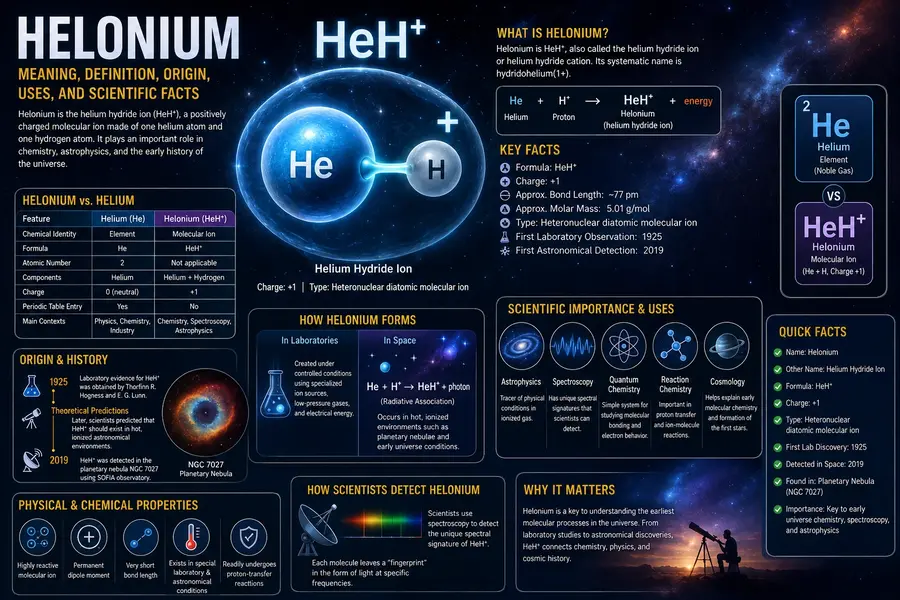
The name “Helonium” is an unusual scientific term that might sound like a chemical element and can be confusing. Indeed, this is a completely different sort of substance – a helium hydride ion, or HeH⁺. The molecular ion is positively charged and is comprised of one helium atom and one hydrogen atom with a net charge of +1.
The name is particularly interesting because helium is known as a chemically inert noble gas. Helium is unreactive towards compounds under normal conditions. HeH⁺ is the evidence as to how, under the correct energy conditions, helium can form a molecular ion with hydrogen.
Helonium has a fascinating history linking laboratory chemistry, Quantum physics, Spectroscopy, and Astronomy. The first laboratory evidence for the helium hydride ion was obtained in 1925. Decades later, scientists foretold that it should also exist in some astronomical environments. The presence of this object in space was only confirmed in 2019 by observations of the planetary nebula NGC 7027.
The ion is also important for understanding the chemistry of the early universe. Helonium is therefore not just an odd chemical name but a very real chemical. It offers scientists a helpful model of the interaction of the simplest atoms in the initial stages of molecular chemistry.
What Is Helonium?
At its simplest, helonium is HeH⁺, commonly called the helium hydride ion or helium hydride cation. Its systematic chemical name is hydridohelium(1+).
The formula contains two elements. “He” represents helium, while “H” represents hydrogen. The plus sign indicates that the entire molecular ion carries one positive electrical charge.
One useful way to describe HeH⁺ is as protonated helium. In a simplified representation, a helium atom interacts with a hydrogen ion, which in this context can be considered a proton:
He + H⁺ → HeH⁺ + energy
The actual chemistry is more complex than this simple equation suggests, particularly in astrophysical environments. Nevertheless, it provides an accessible picture of how the ion can form.
Helonium is classified as a heteronuclear diatomic molecular ion. “Diatomic” means it contains two atoms, while “heteronuclear” means those atoms belong to different chemical elements.
This classification immediately separates helonium from elemental helium. Helium is an element represented on the periodic table by He. Helonium is a molecular ion made from helium and hydrogen.
Is Helonium a Chemical Element?
No. There is no chemical element named helonium.
Helium is the element with atomic number 2. It has two protons in its nucleus and, when electrically neutral, two electrons.
HeH⁺ is different. It contains a helium atom and a hydrogen atom and carries a positive charge. Because it is a molecular ion rather than an element, it does not have its own atomic number or separate position on the periodic table.
This distinction is important because the name “helonium” can make the substance sound like a newly discovered element. It is not. It is a real chemical species with a specific molecular structure and electrical charge.
Helonium vs. Helium
The names helium and helonium are similar enough to cause confusion, but their identities are very different.
Helium is a noble gas and chemical element. It is highly stable because its first electron shell is completely filled. This stability is responsible for helium’s well-known lack of reactivity under ordinary conditions.
Helonium, on the other hand, is HeH⁺. It contains helium and hydrogen and has a positive charge.
| Feature | Helium | Helonium |
|---|---|---|
| Chemical identity | Element | Molecular ion |
| Formula | He | HeH⁺ |
| Atomic number | 2 | Not applicable |
| Components | Helium | Helium + hydrogen |
| Charge | 0 for neutral helium | +1 |
| Periodic-table entry | Yes | No |
| Main scientific contexts | Physics, chemistry, industry | Chemistry, spectroscopy, astrophysics |
Helium has many practical applications, including cryogenic cooling, leak detection, specialized manufacturing, and scientific research. Helonium does not have comparable everyday uses.
The difference also demonstrates an important principle in chemistry: an element’s behavior can change dramatically when it becomes part of an ion or molecular species.
Origin and History of Helonium
The scientific history of HeH⁺ began in the early twentieth century.
In 1925, chemists Thorfinn R. Hogness and E. G. Lunn produced experimental evidence for the helium hydride ion while studying low-pressure mixtures containing hydrogen and helium. Their work demonstrated that helium, despite its reputation as an inert noble gas, could participate in a molecular ion under appropriate conditions.
The discovery became even more significant when scientists began considering whether HeH⁺ might naturally occur in space.
Theoretical models suggested that the ion could form in hot, ionized astronomical environments. Researchers also proposed that it could have existed during the early history of the universe, when conditions allowed the first molecular bonds to develop.
However, directly detecting HeH⁺ in space proved extremely difficult.
Scientists knew what spectral signature to search for, but astronomical observations contain radiation from many different sources. Separating the specific signal of helium hydride from surrounding emissions required highly sensitive instruments and careful observation.
The major breakthrough came in 2019.
Researchers using NASA’s SOFIA airborne observatory detected the characteristic spectral signature of HeH⁺ in the planetary nebula NGC 7027. The observation provided the first confirmed astronomical detection of the helium hydride ion.
This was an important scientific milestone because it connected decades of laboratory experiments and theoretical predictions with direct astronomical evidence.
The Chemistry Behind Helonium
Helonium is particularly interesting because it involves helium, an element known for its chemical stability.
A neutral helium atom has two electrons occupying its first electron shell. That filled shell makes helium resistant to forming ordinary chemical bonds.
However, HeH⁺ is not a conventional neutral molecule. Its positive charge and electronic structure allow a helium atom to interact strongly with hydrogen.
The ion can be viewed as a very simple molecular system containing two nuclei and a small number of electrons. Because its structure is relatively simple, researchers can use sophisticated quantum-mechanical calculations to study its properties with considerable precision.
HeH⁺ also has a permanent electric dipole moment. This property is particularly important for spectroscopy because it gives the molecule characteristic transitions that can be detected by sensitive instruments.
The bond between helium and hydrogen is very short. Commonly cited calculations place its bond length at roughly 77 picometers, although the exact description depends on the quantum state and method of calculation.
The simplicity of HeH⁺ makes it scientifically valuable. It serves as a useful model for studying molecular bonding, proton transfer, reaction dynamics, and the behavior of ions.
Physical and Chemical Properties
Helonium is not a material that can be stored in a container like ordinary helium gas.
It is a highly reactive molecular ion that exists under specialized conditions, including certain laboratory plasma environments and astronomical regions.
Some important facts include:
- Formula: HeH⁺
- Common name: Helium hydride ion
- Systematic name: Hydridohelium(1+)
- Charge: +1
- Type: Heteronuclear diatomic molecular ion
- Atoms: One helium atom and one hydrogen atom
- Approximate molar mass: 5.01 g/mol using common isotopic compositions
- Approximate bond length: 77 pm
- First laboratory observation: 1925
- First confirmed astronomical detection: 2019
Its high reactivity means it does not behave like an ordinary stable chemical compound. In particular, it can readily participate in proton-transfer reactions.
This is why descriptions of HeH⁺ as an exceptionally strong acid must be understood in the context of chemical ion behavior rather than conventional bottled acids.
There is no ordinary “helonium acid” product that consumers can purchase or handle.
How Helonium Forms
There are two major settings in which scientists discuss the formation of HeH⁺: laboratories and astronomical environments.
Laboratory Formation
In laboratory experiments, researchers can create helium hydride ions under carefully controlled conditions. Specialized ion sources, low-pressure gases, electrical energy, and spectroscopic equipment can be used to generate and study the species.
Because HeH⁺ is reactive, scientists typically study it shortly after formation rather than attempting to store it as a stable substance.
Formation in Space
One important astrophysical formation pathway can be represented as:
He + H⁺ → HeH⁺ + photon
This process is known as radiative association. When helium and a proton interact and form a bound molecular ion, excess energy can be released as a photon.
The resulting HeH⁺ can subsequently undergo reactions that destroy it or transfer its proton to other species.
These reactions are especially significant when studying the chemistry of hot, ionized gas.
Helonium and the Early Universe
One of the most fascinating aspects of helonium is its connection to cosmic history.
The early universe was extremely hot and energetic. As the universe expanded, temperatures gradually fell. Eventually, conditions became suitable for electrons and atomic nuclei to combine and form neutral atoms.
Helium and hydrogen became major components of the young universe. Under appropriate conditions, helium could interact with hydrogen ions and form HeH⁺.
For this reason, researchers consider HeH⁺ an important part of models describing the earliest stages of molecular chemistry.
It is sometimes described as the first molecular bond in the universe, although this popular phrase should be treated carefully. Scientific descriptions depend on the exact definition of “first molecule” and the conditions being considered.
A more precise statement is that HeH⁺ is expected to have been an important early molecular species in the developing universe.
Its chemistry may also have contributed indirectly to the formation of molecular hydrogen, H₂. Molecular hydrogen later became extremely important because it helped gas clouds cool and played a role in the formation of the first stars.
In this way, a tiny two-atom ion can provide clues about enormous cosmic processes.
Helonium in Modern Astrophysics
The 2019 detection of HeH⁺ in NGC 7027 was one of the most important milestones in the study of this ion.
Planetary nebulae provide suitable environments for HeH⁺ because they contain hot gas, radiation, and regions where ions and atoms interact.
The detection was accomplished using the German Receiver for Astronomy at Terahertz Frequencies (GREAT) instrument aboard SOFIA.
Researchers identified the characteristic spectral line associated with HeH⁺. This provided strong evidence that the ion was present in the nebula.
The result was scientifically valuable for several reasons.
First, it confirmed that a species predicted by theory could actually be observed in an astronomical environment.
Second, it helped researchers better understand the chemistry occurring in planetary nebulae.
Third, it strengthened models concerning the chemistry of the early universe.
The discovery demonstrates how astronomy and chemistry often overlap. Astronomers can use molecular signatures as fingerprints to identify substances that are impossible to collect physically from distant objects.
Uses and Scientific Importance of Helonium
The word “uses” can be slightly misleading when discussing HeH⁺ because it has few practical consumer or industrial applications.
Its value is primarily scientific.
Astrophysics
HeH⁺ can act as a tracer of particular physical conditions in space. Detecting its spectral signature can help scientists study ionized gas and chemical processes in astronomical objects.
Spectroscopy
Because HeH⁺ has recognizable spectral transitions, researchers can use spectroscopy to identify and study it.
Quantum Chemistry
Its simple structure makes it a useful theoretical model. Scientists can test sophisticated calculations involving molecular bonding and electron behavior.
Reaction Chemistry
HeH⁺ is important in studies of proton transfer and ion-molecule reactions.
Cosmology
Models of early-universe chemistry use HeH⁺ to investigate how the first molecular species could have formed and participated in later chemical processes.
Therefore, helonium is better thought of as a scientific research subject than as a commercially useful chemical.
Does Helonium Have Medical or Industrial Uses?
There are no established medical applications for HeH⁺.
This is sometimes confused with the medical and scientific uses of elemental helium. Although helium is part of the name, helium and HeH⁺ have dramatically different properties.
Likewise, helonium does not have major industrial applications.
Industrial helium is useful because it is chemically inert and has an exceptionally low boiling point. It is used in areas such as cryogenics, leak detection, and specialized manufacturing.
HeH⁺ is too reactive and short-lived under ordinary conditions to serve the same purposes.
Its importance is therefore primarily found in fundamental research.
How Scientists Detect Helonium
Scientists cannot identify HeH⁺ simply by looking at it. Instead, they rely heavily on spectroscopy.
Molecules and molecular ions interact with electromagnetic radiation in characteristic ways. When they absorb or emit radiation at particular frequencies, they produce spectral signatures.
These signatures can function like fingerprints.
For HeH⁺, researchers know which transitions to look for based on laboratory measurements and theoretical calculations.
The 2019 astronomical detection succeeded because scientists could compare observed radiation from NGC 7027 with the expected signature of the helium hydride ion.
This approach is common throughout astronomy. Scientists identify molecules in distant stars, nebulae, and interstellar clouds by studying the radiation they emit or absorb.
Helonium therefore provides an excellent example of how something that cannot be directly collected from space can nevertheless be identified with strong scientific confidence.
Common Misconceptions About Helonium
Helonium is a new element
This is incorrect. Helonium is a molecular ion, not an element.
Helonium is another name for helium
It is not. Helium is He, while helonium is HeH⁺.
Helonium has its own atomic number
It does not. Atomic numbers belong to individual chemical elements.
Helonium is a stable gas
HeH⁺ is not a normal gas that can be stored under everyday conditions.
Helonium is fictional
No. The helium hydride ion is a real chemical species that has been produced experimentally and detected astronomically.
Helonium has everyday industrial uses
There are no major commercial applications comparable to those of elemental helium.
Understanding these distinctions makes it much easier to separate legitimate scientific information from misleading descriptions found online.
Why the Name Helonium Causes Confusion
The name itself is partly responsible for the confusion.
Many chemical elements have names ending in “-ium,” including helium, lithium, sodium, and uranium. As a result, “helonium” can sound like the name of an undiscovered or newly created element.
However, the “-onium” ending is also used in chemical terminology for certain positively charged species.
Examples include hydronium and ammonium.
In the case of helonium, the name points toward helium while the ending reflects its ionic character.
When researching the term, it is therefore useful to search not only for “helonium” but also for:
- HeH⁺
- helium hydride ion
- helium hydride cation
- hydridohelium(1+)
- protonated helium
Scientific papers often use HeH⁺ or helium hydride ion rather than the less common word helonium.
Final Thought
Helonium is a fascinating example of how a seemingly obscure scientific term can connect fundamental chemistry with the history of the universe. The term refers to HeH⁺, the helium hydride ion, a positively charged molecular species containing one helium atom and one hydrogen atom.
Its story began with laboratory research in 1925 and continued through decades of theoretical and experimental investigation. The first confirmed detection of HeH⁺ in space in 2019 provided an important link between laboratory chemistry, astronomical observation, and models of early cosmic chemistry.
Although helonium is not a chemical element and has no major everyday commercial use, its scientific importance is considerable. Researchers study it to better understand molecular bonding, spectroscopy, ion chemistry, planetary nebulae, and the development of molecular chemistry in the early universe.
For anyone searching for the helonium meaning, the key fact is simple: helonium is another name associated with the helium hydride ion, HeH⁺. What makes it remarkable is not its practical use but the insight this tiny molecular ion provides into some of the earliest chemical processes in the cosmos.
FAQs
What does helonium mean?
Helonium refers to the helium hydride ion, HeH⁺, a positively charged molecular ion made from one helium atom and one hydrogen atom.
Is helonium a chemical element?
No. Helonium is not an element and does not have its own atomic number or position on the periodic table.
What is the formula for helonium?
The chemical formula for helonium is HeH⁺.
Is helonium the same as helium?
No. Helium is a chemical element represented by He, while helonium refers to the positively charged helium-hydrogen molecular ion HeH⁺.
When was helonium first produced?
Experimental evidence for the helium hydride ion was reported in 1925 by Thorfinn R. Hogness and E. G. Lunn.
When was helonium detected in space?
The first confirmed astronomical detection of HeH⁺ was reported in 2019, in the planetary nebula NGC 7027.
Why is helonium important?
HeH⁺ is important for studying molecular chemistry, ion reactions, spectroscopy, astrophysics, and the chemistry of the early universe.
Does helonium occur naturally on Earth?
HeH⁺ can be generated under specialized laboratory conditions, but it is not a stable substance that naturally accumulates in Earth’s atmosphere or environment.
Does helonium have medical uses?
There are no established medical applications for HeH⁺. Its importance is primarily scientific.
Does helonium have industrial uses?
Helonium does not have major industrial applications. Unlike elemental helium, it is mainly studied for its chemical and astrophysical significance.
